

Doctor explains: What causes ME/CFS? Research update on the proposed mechanisms behind ME/CFS
Updated: Aug 30

Many people diagnosed with ME/CFS ask the same question: What is actually causing this illness?
The honest answer is that researchers still do not have one single explanation. But over the last few years, especially with increased interest in Long COVID research, scientists have made important progress.
As an ME/CFS specialist and online ME/CFS doctor, one of the most common misconceptions I hear is that ME/CFS is simply “being tired.” Modern research increasingly suggests something far more complex: ME/CFS appears to be a multi-system illness affecting energy production, immune function, the nervous system, and how the body responds to exertion.
If you are seeking ME/CFS testing, ME/CFS therapy, or specialist assessment, understanding these mechanisms can help explain why symptoms can feel so severe despite normal routine blood tests.
Why is ME/CFS difficult to explain?
ME/CFS does not behave like many traditional diseases. Researchers increasingly believe that ME/CFS may involve multiple overlapping biological problems rather than one single cause.
This complexity is one reason why specialist assessment from an experienced ME/CFS specialist can be important.
1. Immune system dysfunction
One of the strongest areas of ME/CFS research involves abnormal immune responses.
Many patients report their symptoms beginning after viral infections. Researchers have identified evidence suggesting altered immune signalling, chronic low-grade inflammation, and abnormal responses following physical exertion. Recent work suggests that abnormal activation of innate immunity may contribute to worsening symptoms after activity.
Researchers are particularly interested in:
Abnormal inflammatory signalling
Changes in natural killer and T-cell function
Persistent immune activation after infections
Presence of abnormal antibodies
Altered cytokine patterns
This is also why ME/CFS and post-viral illnesses often overlap clinically.
For patients attending a Long COVID fatigue clinic or seeing a post-viral fatigue doctor, these similarities may feel familiar because both conditions appear to involve disrupted immune regulation.
2. Problems with energy production
Many researchers now believe energy metabolism plays an important role.
Patients often describe symptoms that feel very different from normal tiredness:
Muscles feel weak after small tasks
Recovery takes days rather than hours
Physical or cognitive activity causes symptom worsening
Simple activities can trigger crashes
Research increasingly suggests that cells may struggle to produce or use energy efficiently. Recent studies have reported abnormalities involving mitochondrial pathways, fatty acid metabolism, and cellular energy systems. Researchers have also observed evidence consistent with energetic stress in some studies.
This may help explain why pacing strategies and carefully tailored ME/CFS therapy often become important parts of management.
3. Post-exertional malaise: the key feature researchers are studying
The hallmark symptom of ME/CFS is usually post-exertional malaise (PEM).
This means symptoms worsen after physical, cognitive, emotional, or social exertion.
Researchers increasingly consider PEM central to understanding ME/CFS because exercise does not appear to produce normal physiological responses in many patients. Studies examining Long COVID and ME/CFS continue investigating why exertion can trigger delayed symptom worsening.
Importantly, researchers increasingly recognise that PEM is not simply “deconditioning.”
This is one reason why modern specialist assessment often focuses heavily on identifying exertional intolerance.
4. Nervous system dysfunction
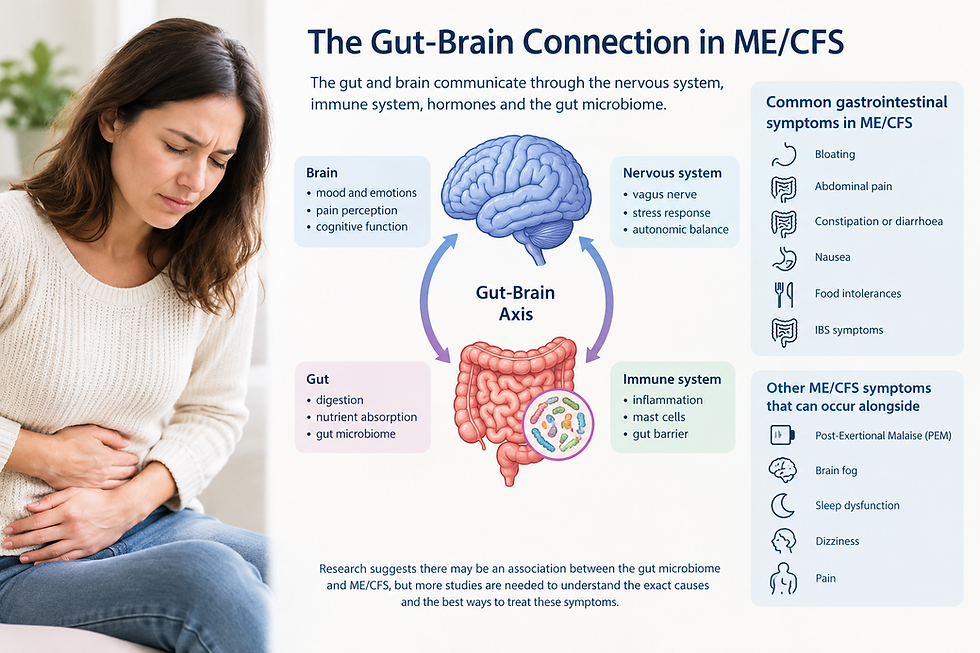
Many researchers believe the autonomic nervous system may be involved.
The autonomic nervous system controls automatic body functions such as:
Heart rate
Blood pressure
Temperature regulation
Digestion
Circulation
When these systems function poorly, patients may experience:
Dizziness
Palpitations
Lightheadedness
Brain fog
Exercise intolerance
IBS-like symptoms
Research into neuroinflammation and altered nervous system signalling continues to expand, although many questions remain unanswered. Studies increasingly suggest that interactions between the immune and nervous systems may contribute to symptoms.
5. Genetics and biological susceptibility
One important recent development is growing evidence that some individuals may have a biological susceptibility to developing ME/CFS.
Large genetic studies have identified possible genetic regions associated with immune regulation and disease risk. These findings do not mean ME/CFS is purely genetic, but they support the idea that biological vulnerability may influence who develops persistent illness after infections.
This is particularly relevant for understanding why one person recovers after a virus while another develops chronic symptoms.
What about Long COVID?
Long COVID has dramatically accelerated ME/CFS research.
Many people attending a Long COVID fatigue clinic have symptoms overlapping significantly with ME/CFS:
Fatigue
Brain fog
Exercise intolerance
Autonomic symptoms
Post-exertional symptom worsening
However, researchers are also discovering important differences, suggesting these conditions may overlap without being identical. Both similarities and differences remain active areas of research.
This overlap explains why many patients seek assessment from an online ME/CFS doctor or post-viral fatigue doctor with experience across both conditions.
Are we close to an ME/CFS test?
Many patients ask whether reliable ME/CFS testing is finally arriving.
Research into biomarkers and biological changes in ME/CFS is progressing rapidly. Current ME/CFS research is exploring immune system abnormalities, mitochondrial dysfunction, autonomic nervous system changes, inflammation, and epigenetic patterns that may help improve future diagnosis and treatment.
Our clinic will soon be offering advanced epigenetic testing as part of our specialist assessment pathway. Epigenetics looks at how genes are switched on or off in response to factors such as illness, stress, infection, and environmental influences. Emerging ME/CFS research suggests that epigenetic changes may play an important role in post-viral fatigue syndromes, including ME/CFS and Long COVID.
While epigenetic testing is still an evolving area of medicine, it may help provide further insight into biological processes associated with chronic fatigue conditions. As an online ME/CFS doctor service and Long COVID fatigue clinic, we continue to follow developments in evidence-based testing and personalised approaches to care.
An experienced ME/CFS specialist can help determine which investigations are appropriate and interpret results in the context of your symptoms and overall health.
What does this mean for treatment?
Research increasingly supports the idea that ME/CFS is a genuine biological illness involving multiple body systems.
Unfortunately, research has not yet produced a single curative treatment.
Current management usually focuses on:
Accurate diagnosis
Identifying post-exertional malaise
Activity management and pacing
Symptom-targeted treatment
Investigating overlapping conditions
Individualised ME/CFS therapy approaches
Patients with overlapping pain symptoms may also benefit from assessment by a fibromyalgia specialist online, where appropriate.
Final thoughts
The biggest change in recent years is not that researchers have discovered one answer.
Instead, researchers increasingly recognise that ME/CFS appears to involve complex interactions between immunity, metabolism, the nervous system, and responses to exertion. The growth of Long COVID research has accelerated this process considerably.
If you would like to learn more:
About the doctor: https://www.ukmecfsspecialist.co.uk/
Relevant conditions and articles: https://www.ukmecfsspecialist.co.uk/blog
If you would like a specialist assessment, learn more about our online consultations.
Prof. Dmitry Pshezhetskiy, MBBS, PhD, MRCGP
GMC 7494518 — Registered Medical Practitioner (GP)
Medical Disclaimer: The information provided in this article is for general educational and informational purposes only and does not constitute personalized medical advice, formal diagnosis, or treatment planning. Reading this content or communicating via this website does not establish a doctor-patient relationship with Prof Dmitry Pshezhetskiy. ME/CFS affects every individual differently; strategies discussed may not be suitable or safe for your specific health situation. Always consult your GP, specialist healthcare team, or NHS 111 regarding your personal medical concerns. In a medical emergency, please dial 999 or visit your nearest Emergency Department immediately. For a full disclaimer, see Medical Disclaimer & Terms of Use in Terms and Conditions on the policies page.


Understanding the pharmacokinetic (PK) and toxicokinetic (TK) profiles of drug candidates is essential for de-risking development and guiding data-driven decision-making in the preclinical stage.